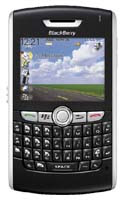
 BlackBerry 8800 As stylish as it is powerful, the BlackBerry® 8800 smartphone is designed to let you do your best work from wherever you choose. It gives you phone, email, organizer, web browsing and instant messaging. And then it goes a step further, providing GPS for enhanced access to location based applications and services, including the pre-loaded BlackBerry® Maps application. A media player for your video clips and music. Expandable memory to ensure you've got the room you need for your media files. And a high-capacity battery to allow you to make the most of it all.•Quad-Band: 850/900/1800/1900 MHz GSM/GPRS, EDGE + Wi-Fi
•Email•Phone and SMS•Corporate Data Access•Organizer•Wireless Internet•BlackBerry Maps•Trackball, ESC key and Menu key•Integrated earpiece and microphone•Integrated speakerphone•Bluetooth v2.0; headset, hands-free and serial port profiles supported•Polyphonic, MP3 & MIDI ringtones, vibrate, on-screen or LED indicator•Embedded RIM wireless modem•Supported by version 4.2 or higher•Ultra Thin•Full QWERTY keypad•Large 320 x 240 screen•Full multimedia feature set•Possible on some versions of the 8800 (Camera - 1.3 mp, 5x digital zoom, flash and maybe even video recording)•Media Player - audio and video playback (Built-in streaming*) stereo headset compatible.•64 MB Flash, expandable memory (Micro SD)•Great phone experience w/ Advanced noise and echo cancellation•Voice activated dialing, speakerphone, Bluetooth 2.0BlackBerry 8800 Technology by
taume
The seemingly exponential growth of portable technology has sparked fears that people are becoming addicted or swamped by gadgets and their uses. One major consequence of this phenomenon is that the line between work and private life is much more blurred, now that e-mail and phones provide a 24-hour link between employers and staff.
Experts believe that even the decision-making process of the average person can be adversely affected.
However, others think that the bombardment of various communications can enhance the brain's ability to process information. Addiction symptoms
Nada Kakabadse, a Professor at the Northampton Business School, said: "Your judgement is impaired. Equally your decision making processes are impaired.
"It's like losing your spatial judgement, so instead of walking through the door you walk in to it. You're more prone to have a car accident if you drive."
Prof Kakabadse added: "It's addiction to portable technology, which you take with you practically to bed, the cinema, to the theatre, to a dinner party. The symptoms are, like with any other addiction, that people spend more time using their technology than spending it in socialising or in family time." The growing importance of the issue was highlighted at a gathering in Geneva, Switzerland, for the LIFT 07 technology conference.
One of the conclusions reached by experts was that "tech overload" is the price people have to pay for always-on communication, where the line between work and play has become blurred. In fact, there is even some evidence that being bombarded with information from all directions is actually beneficial.
Professor Fred Mast, of the University of Lausanne, said: "I think that we can become overloaded. It depends on the situation, but I think we are underestimating the brain's capacity to adapt to new challenges.
"Studies have been done showing that people can actually enhance their cognitive abilities, which helps them to process more information at the same time. And their performance even transfers to other tasks."Experts have also noted how different types of technology have developed their own etiquette. For instance, an e-mail can wait two days to be answered but a text message demands an almost immediate reply.
Stefana Broadbent from Swisscom said: "E-mail is considered the most formal. At the other end of the spectrum SMS is the most personal of all.
"That's where we find all those little exchanges, little endearments, what we call grooming, which is sending: 'I think about you. How did it go? How did you sleep?' He added: "That is actually given by the number of characters. With such few characters, you have to have a lot of mutual understanding and mutual knowledge."
Prof Kakabadse added that prioritising was a vital way to prevent communication overload.
She said: "I really think it is the responsibility of the individual to prioritise. Even if an employee pushes the boundaries, do discuss with the employee in a constructive way how we can do things better without being overloaded."Technology News by
BBC
Windows Vista is causing problems for some new PC owners hooking up their machine to a broadband connection. Some old installation discs that simplify the task of configuring a PC for broadband have refused to work on machines loaded with Vista.
One reader was warned by Virgin Media that it would be "weeks" before its software worked with Vista.
Other net service firms have also admitted that the appearance of Vista has caused some hiccups for users. Disc delays
Microsoft launched the consumer versions of Windows Vista on 30 January and anyone buying a PC since that date is likely to have it installed on their brand new machine.
Many are thought to have suffered the same problem as Swansea-based Rob Evans who found that he could not use his existing Virgin Media account with his new PC from Tesco.
After ringing Virgin for help he was told that Vista support may not be forthcoming for some time.
A spokesman for Virgin Media, formerly NTL/Telewest, admitted that its discs did not yet work with Vista but added that Mr Evans was now using his broadband service.
"We can get people online without the installation disc," he added. "It's not that it does not work, it's just the disc."
The spokesman said that other net service firms were also known to be taking time to get to grips with Vista. "It's such a big product that to train staff up on it fully and make sure all your services are tested and compliant takes time," he said.
A spokesman for BT said: "I think we are now supporting it though we did have some issues with it."
In particular, he said, Vista was conflicting with the Norton security software that BT sells with some of its broadband bundles.
"That's now been ironed out," he added.
The spokesman said BT had created a help page devoted to Vista to make it easier for people to get their PC connected. Net service firm Tiscali advises its users to back-up important data on their Vista PC before attempting to connect it to broadband.
Andrew Ferguson, editor at Think Broadband, said: "I suspect Vista is going to break a lot of things as it makes some major changes to how things are done in Windows."
"Many places aren't up to speed with Vista yet," he said.Windows Vista Technology by
BBC
A humanoid robot is teaching itself to walk and eventually run around a California research lab. Dexter took its first tentative steps only a few days after it first discovered how to stand upright.
Dexter's designers say their robot differs from commercially available predecessors because it can learn from its mistakes. It is the culmination of six years' work by Anybots, an independent research group of three engineers. Founder, Trevor Blackwell, said: "When we started out Dexter had a very general idea of what a walking motion should look like.
"The first time it [tried] it just fell over right away.
"100 times a second we record about 200 different things: the position of the joints, the forces on the feet, and also the equivalent of what the inner ear measures: the way the body is tilting." Jobs humans do
Dexter then analyses this information to modify its movements.
Dr Blackwell said walking robots currently on the market, such as Honda's Asimo, differ because their creators programmed their movements before they were switched on.
He said he was talking to industrial companies to develop Dexter for jobs people usually carry out in protective clothing.
The aim is to design a robot that can adapt to several environments and roles, like a human does, rather than requiring specific programming.
Before Dexter is ready for work it has to develop in a similar way to a child - with some coaxing but plenty of self-motivation. 'Running within months'
The developers are setting it new tasks all the time, said Dr Blackwell.
"We're trying to work like trainers do," he explained. "We think no, no, you've got to do that faster."
Anybots hopes Dexter will have taught itself to run within a few months.
If it does it will be following in Asimo's footsteps. The Japanese cousin mastered the art of speed more than two years ago and can run at a three kilometres an hour.Robot Technology by
BBC


